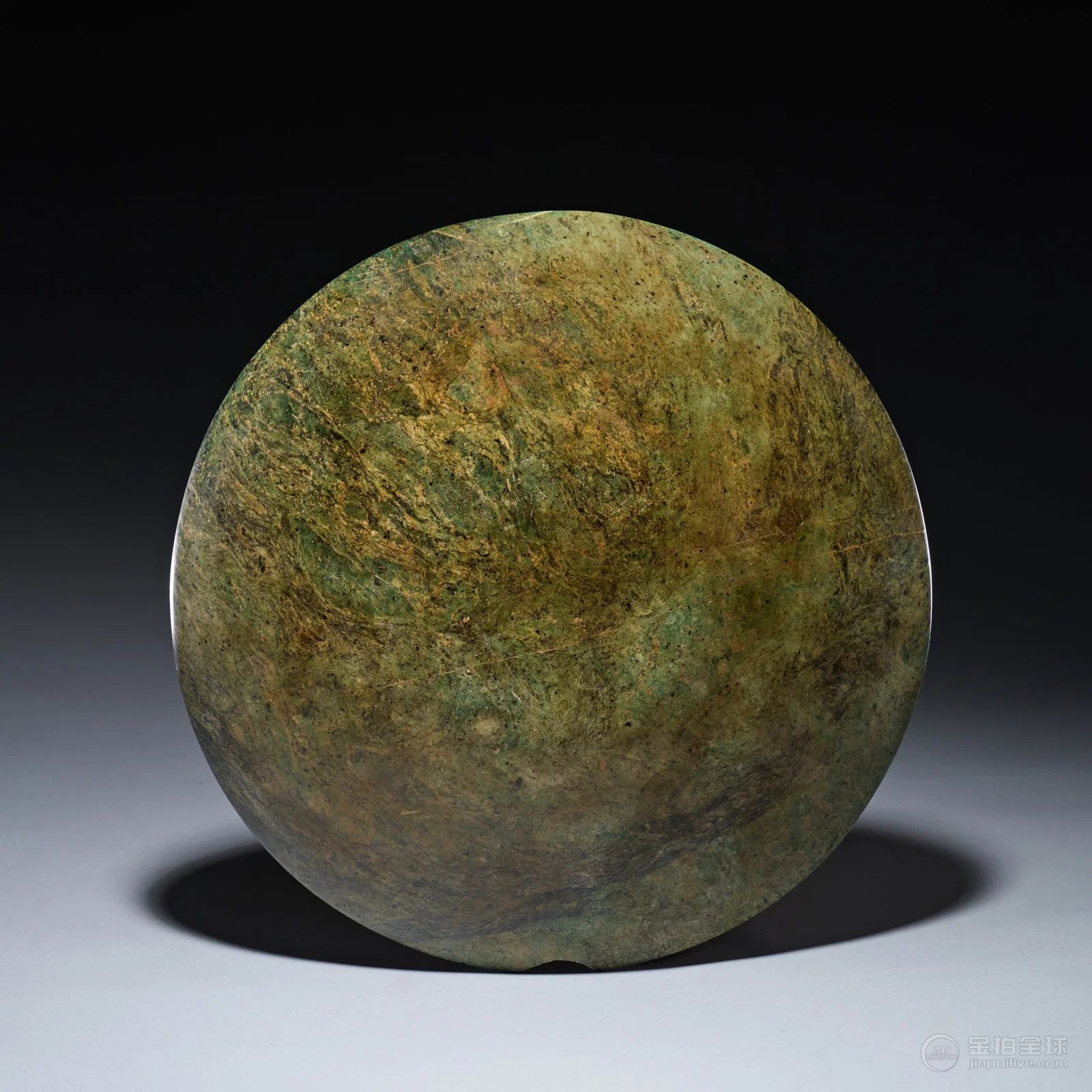
A RARE EGYPTIAN SERPENTINE PREDYNASTIC DISH, NAQADA II-III, CIRCA 3200 B.C.
拍卖行: PLAKAS
专场: 古代艺术II
拍品描述
A RARE EGYPTIAN SERPENTINE PREDYNASTIC DISH, NAQADA II-III, CIRCA 3200 B.C. Of shallow circular form, the broad disc rising from a low, hollowed underside to a thin, level rim, the underside centred by a raised concentric ring defining a modest recessed foot. The stone is worked to an even section throughout, the walls tapering finely towards the perimeter, with a single small notched interruption at the edge. The surface retains its natural mottled colouration, ranging from deep bottle-green to olive and rust-brown, veined and clouded by the mineral's inherent banding. A shallow chip is visible at the rim, and the body carries the light abrasions and softened contours consistent with long burial. The form is austere and depends entirely on proportion and the qualities of the stone itself. There is no incised or applied decoration; the ornament is the material. The Predynastic lapidary allowed the natural figuring of the serpentine, its swirling greens and ochres, to serve as the sole visual interest, a decision fully consistent with the aesthetics of the late Naqada period, when stone vessels were prized precisely for the play of colour and pattern released by patient grinding and polishing. Stone vessels of this class were produced in Upper Egypt during the fourth millennium B.C. by a labour-intensive process of hollowing with tubular drills and abrasives, followed by grinding of the exterior against progressively finer stones. Serpentine, together with basalt, diorite, breccia, and travertine, belonged to a hierarchy of harder ornamental stones favoured for prestige objects deposited in the elite graves of the Naqada II and III phases. The choice of material was not incidental. Serpentine was quarried from limited sources in the Eastern Desert, and its working required specialised knowledge; vessels in this stone appear consistently in high-status funerary contexts at sites such as Naqada, Hierakonpolis, and Abydos, where they accompanied the emerging ruling class of the late Predynastic period into the tomb. The shallow open dish is among the more demanding forms in the Predynastic stoneworker's repertoire, since the thin walls and wide diameter require even reduction across the whole surface without fracture. The presence of a defined foot ring on the underside, rather than a plain convex base, indicates a maker working within a settled formal vocabulary in which the vessel was intended to sit level on a flat surface, whether in life or in the arrangement of the burial assemblage. Such dishes are generally understood as tableware for the elite dead, appearing alongside cosmetic palettes, flint knives, and ceramic jars in graves of the period immediately preceding the unification of Egypt. This dish exemplifies the Naqada lapidary tradition at its most restrained, where the entire aesthetic effort is directed toward form and the revelation of the stone's natural figure. It belongs to the material culture out of which the pharaonic stone-vessel industry emerged, and stands as an object from the threshold of Egyptian dynastic civilisation. Dimensions: 35.5 cm
图片